In a world where cyber attacks are becoming more targeted, more organized, and more frequent, organizations can no longer rely solely on firewalls, compliance checklists, and antivirus software. Real attackers don’t follow rules — they follow opportunities. This is why Red Teaming has become one of the most valuable and realistic security practices in the world.
Red Teaming is not simply “advanced penetration testing.”
It is a holistic attack simulation designed to assess real-world threats and how well an organization can:
a. Prevent
b. Detect
b. Respond
d. Recover
1. What Exactly Is Red Teaming?
Red Teaming is a controlled, authorized adversarial simulation that mimics how real threat actors operate, including cybercriminals, insiders, and nation-state groups.
The goal is not to find “as many vulnerabilities as possible.”
The goal is to demonstrate real, exploitable attack paths that lead to high-impact outcomes such as:
a. Compromising domain admin
b. Stealing sensitive data
c. Gaining access to production servers
d. Moving laterally across departments
e. Bypassing SOC detection
f. Maintaining covert persistence
Penetration Testing asks “What vulnerabilities exist in our systems?”
Red Teaming asks “Can an attacker achieve their objective? If yes, how? If not, why?”
2. Why Is Red Teaming Important Today?
2.1 Attackers Evolve Faster Than Defenders:
Ransomware groups now operate like tech companies, Nation-state actors run multi-year operations and Insiders can exfiltrate data in seconds. Organizations need simulated exposure to real threats, not theoretical weaknesses.
2.2 Traditional Testing Does Not Measure Detection & Response:
A company may have SIEM, EDR, Firewall, SOC team, SOAR automation etc but can they:
i. Detect a Kerberoasting attack?
ii. Can they identify Command-and-Control traffic hidden in DNS queries?
iii. Can they catch brute-force attempts spread over 1000 IPs?
These are just few examples to name a few, there are lot of gaps that can be identified through red teaming.
2.3 Helps Strengthen Security Culture:
Red Teaming exposes weaknesses in human behavior, such as:
i. Employees clicking phishing emails
ii. Developers committing API keys to GitHub
iii. Staff sharing credentials internally
iv. IT teams misconfiguring systems under pressure
2.4 Builds Cyber Resilience for Critical Sectors:
Banks, governments, telecommunication, and healthcare organizations need:
i. Threat visibility
ii. Attack path identification
iii. Infrastructure hardening
iv. Red Teaming provides exactly that.
3. Red Teaming Frameworks:
There are many red teaming frameworks, however below are the most popular ones:
i. MITRE ATT&CK Framework
ii. NIST SP 800-115
iii. TIBER-EU (Europe)
iv. OSSTMM
v. PTES (Penetration Testing Execution Standard
4. Types of Red Teaming
4.1 External Red Teaming (Outside-In Attack Simulation)
External Red Teaming simulates an attacker on the internet, with zero internal access.
The goal: breach the perimeter.
Activities Performed in External Red Teaming
🔍 1. OSINT (Open Source Intelligence)
Google Dorking
GitHub Dorking (API keys, tokens, secrets)
Employee enumeration via LinkedIn
Subdomain enumeration
Certificate transparency lookups
Cloud bucket discovery (S3, Azure Blob, GCP)
Email & credential dumps via Darkweb & Public Forums
Technology Stack Enumeration
🌐 2. External Attack Surface Mapping
Finding Public-facing IPs
Finding Exposed services
Shadow IT assets
Forgotten domains
Expired SSL certificates
Misconfigured servers
💣 3. Vulnerability Discovery & CVE Exploitation
🎣 4. Phishing & Social Engineering
Credential phishing
Multi-factor fatigue attacks
OAuth consent phishing
QR code phishing
WhatsApp/Telegram-based impersonation
📞 5. Vishing (Voice Social Engineering)
Pretending to be IT support
Resetting an employee’s password
Asking for internal access for “urgent fixes”
🌩 6. DDoS Simulation (When in Scope)
Check WAF thresholds
CDN behavior
Rate limiting
Not destruction — controlled stress testing.
4.2 Internal Red Teaming (Assumed Breach)
Internal Red Teaming assumes the attacker already has a low-privilege foothold inside the network.
Activities Performed in Internal Red Teaming:
🔓 1. Credential Access
Attackers attempt to obtain more powerful credentials. Some Techniques include:
LSASS memory dumping
SAM/NTDS.dit extraction
Token impersonation
Kerberoasting
AS-REP roasting
NTLM relay attacks
Credential harvesting via phishing payloads
🏰 2. Active Directory Enumeration & Attacks
Enumerating AD users, groups, GPOs
Enumerating Domain trusts
Privilege delegation
Misconfigured ACLs
GPP password extraction
DNSAdmins exploit
PrintNightmare
Shadow credential injection
LAPS misconfigurations
↔ 3. Lateral Movement
🕵️ 4. Persistence Techniques
Scheduled tasks
Startup folder implants
WMI event subscriptions
Golden Ticket / Silver Ticket
Service backdoors
📤 5. Data Exfiltration Simulations
🏢 6. Physical Security Testing
Tailgating into office buildings
Bypassing RFID access
Plugging into wall LAN ports
Server room compromise
Placing rogue devices (Raspberry Pi implants)
5. How Red Teaming Helps Organizations, Banks & Governments?
Below mentioned are some ways red teaming helps organizations, banks and governments:
a. Validates the Real Security Posture
b. Improves Detection & Response Maturity
c. Protects High-Value Assets
d. Reduces Impact of Real Attacks
e. Builds Long-Term Cyber Resilience
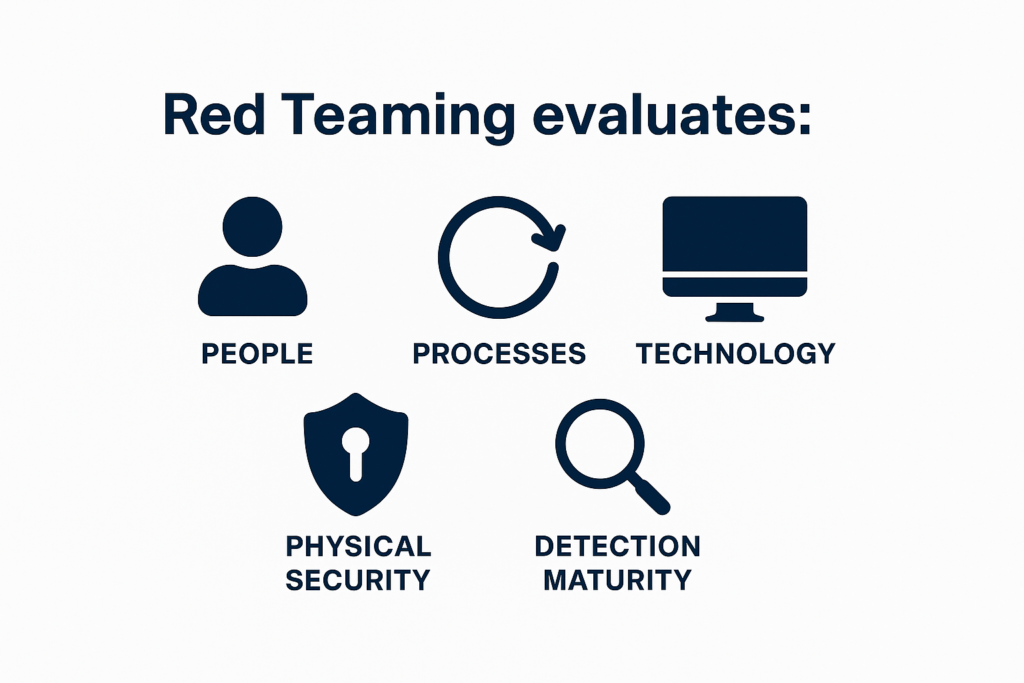
Red Teaming is not just a security assessment — it is a realistic battlefield simulation which uncovers:
i. Weak Technology
ii. Weak Processes
iii. Weak Detection
iv. Weak Human Behavior
More importantly, it helps organizations evolve from being reactive to proactive — and eventually to resilient. Whether you’re a startup, an MNC, a bank, or a government body, Red Teaming provides unmatched visibility into how attackers truly think, operate, and exploit.
Leave a Reply