In any vulnerability assessment, penetration test, or red-team engagement, technology stack enumeration is one of the earliest and most critical activities. Before a single exploit is attempted, before payloads are fired or scanners are unleashed, a skilled security professional first answers a fundamental question:“What exactly is this application built on?”
Understanding the underlying technology stack is not optional—it is the foundation on which every meaningful security decision is made.
What Is Technology Stack Enumeration?
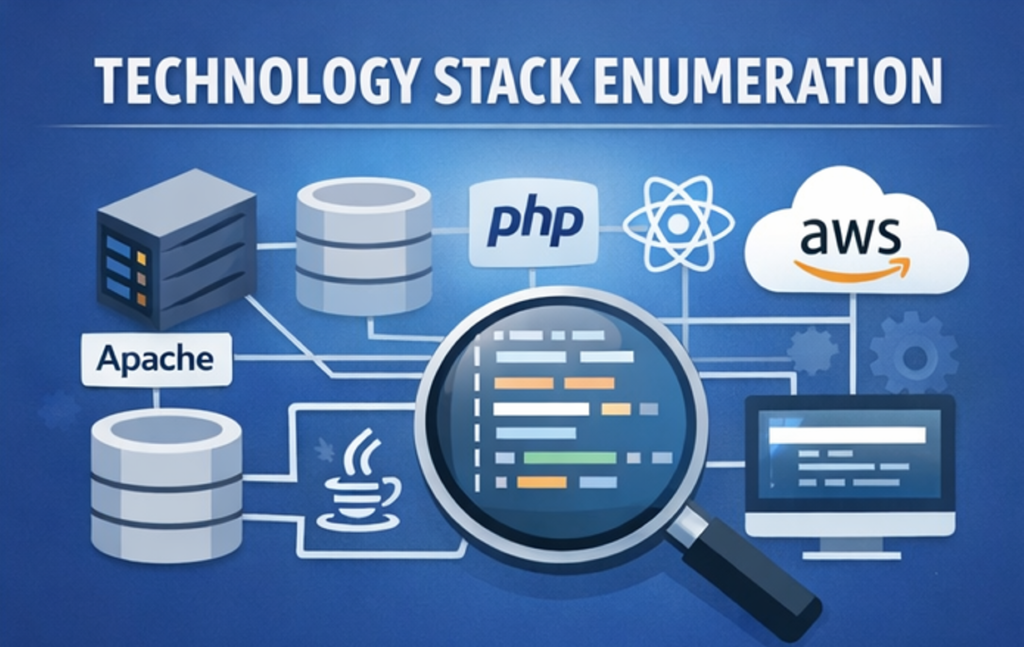
Technology stack enumeration is the process of identifying the frameworks, languages, servers, libraries, databases, and third-party services used by an application or infrastructure. This typically includes:
- Web server and operating system
- Backend programming language and framework
- Frontend frameworks and libraries
- Databases and data stores
- Authentication mechanisms
- CDN, WAF, and cloud services
- Third-party integrations and APIs
From a security standpoint, each technology introduces its own attack surface, configuration pitfalls, and historical vulnerabilities.
1. Determining the Attack Surface
Different stacks expose different vulnerabilities.
- A PHP-based application may be susceptible to:
- Local/Remote File Inclusion (LFI/RFI)
- Object Injection
- Deserialization flaws
- A Java application may expose:
- Insecure deserialization
- Spring Expression Language (SpEL) injection
- Misconfigured Actuators
- A Node.js application may be vulnerable to:
- Prototype pollution
- Dependency confusion
- Insecure JWT handling
Without knowing the stack, testing becomes blind and inefficient.
2. Enables Targeted Vulnerability Testing
Technology stack enumeration allows you to:
- Choose relevant test cases
- Use correct payloads
- Avoid noise and false positives
For example:
- Testing .php parameters on a Java Spring app is pointless.
- Sending OGNL payloads to a Node.js API is ineffective.
- Blind SQL injection testing without knowing the database type often fails.
Knowing the stack means precision over guesswork.
3. Helps Identify High-Risk Dependencies
Modern applications rely heavily on third-party libraries:
- JavaScript frameworks
- Package managers (npm, pip, composer, maven)
- UI components
- Authentication SDKs
A single outdated library can expose:
- Known CVEs
- Authentication bypasses
- Remote Code Execution (RCE)
Technology stack enumeration helps identify:
- Library names
- Versions
- Deprecated or end-of-life components
4. Supports Better Risk Rating and Reporting
From a reporting perspective, stack awareness allows you to:
- Correlate vulnerabilities with business impact
- Explain why a vulnerability exists
- Provide stack-specific remediation guidance
Common Technology Stacks in Use Today
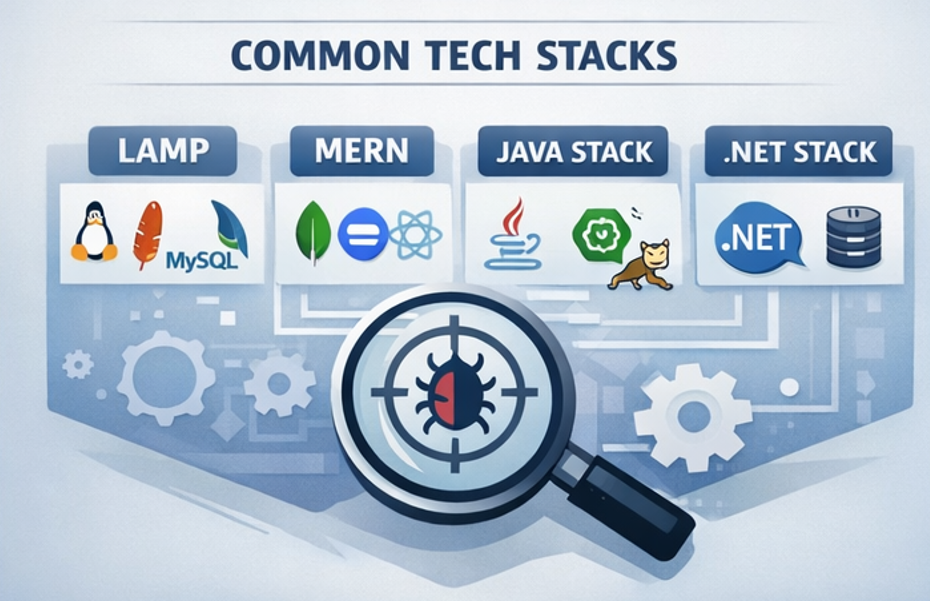
1. LAMP StackLinux, Apache, MySQL, PHPCommon Use Cases:
- Legacy enterprise portals
- CMS platforms (WordPress, Joomla, Drupal)
Security Focus Areas:
- PHP file inclusion
- SQL injection
- Weak file upload validation
- Apache misconfigurations
2. MEAN / MERN StackMongoDB, Express.js, Angular/React, Node.js
Common Use Cases:
- Modern web applications
- Single-page applications (SPAs)
- REST APIs
Security Focus Areas:
- NoSQL injection
- JWT misconfigurations
- Prototype pollution
- CORS misconfigurations
3. Java Enterprise StackJava, Spring Boot, Hibernate, Tomcat
Common Use Cases:
- Banking and financial applications
- Government portals
- Enterprise internal systems
Security Focus Areas:
- Insecure deserialization
- Spring misconfigurations
- Verbose error messages
- Actuator exposure
4. .NET StackASP.NET, IIS, MSSQLCommon Use Cases:
- Corporate intranet applications
- Legacy enterprise software
Security Focus Areas:
- ViewState tampering
- Insecure authentication
- Misconfigured IIS
- Weak cryptographic usage
5. Serverless and Cloud-Native StacksAWS Lambda, Azure Functions, GCP Cloud Functions
Common Use Cases:
- Microservices
- Event-driven APIs
Security Focus Areas:
- IAM misconfigurations
- Over-permissive roles
- Insecure API gateways
- Secrets exposure
6. JAMstackJavaScript, APIs, Markup
Common Use Cases:
- Static sites
- Headless CMS setups
Security Focus Areas:
- Exposed APIs
- Misconfigured CDN
- Client-side secrets
Technology Stack Enumeration in Real-World VAPT
In real-world engagements, enumeration is rarely limited to banners or headers. Advanced testers combine:
- HTTP response analysis
- JavaScript file inspection
- API behaviour observation
- Error message fingerprinting
- TLS and certificate analysis
The goal is not just to know what technologies are used, but how they are configured.
Tools and Plugins for Technology Stack Enumeration
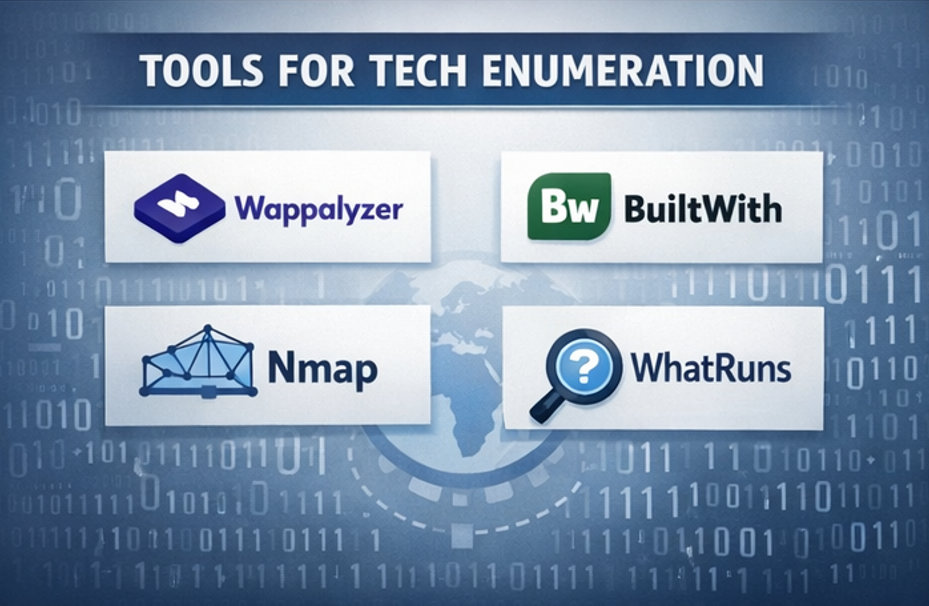
1. Wappalyzer:
Wappalyzer is available as browser extension, cli and api. It is one of the most widely used tools for identifying:
- Web frameworks
- CMS platforms
- Analytics tools
- Server technologies
2. BuiltWith:
Builtwith is a browser extension which is useful for:
- Marketing and analytics detection
- CDN and hosting identification
- Third-party integrations
3. WhatRuns:
WhatRuns is another browser-based plugin that focuses on:
- Frontend frameworks
- JavaScript libraries
- CMS themes and plugins
4. Nmap (Service and Script Detection):
Nmap helps in identifies services and versions. It can also be Useful for backend and infrastructure enumeration.
5. Manual JavaScript Analysis
Often overlooked but is extremely powerful and can help in:
- Identifying framework usage via hardcoded information
- Identifying technology in use via exposed API endpoints
- Identifying technology and framework via internal paths and configs
Technology stack enumeration is not just a reconnaissance step—it is the backbone of effective security testing.“Enumerate first. Exploit second. Report with confidence.”
In a world where applications are increasingly complex, layered, and distributed, understanding what runs under the hood is the difference between shallow testing and professional-grade security assessment.
Leave a Reply